
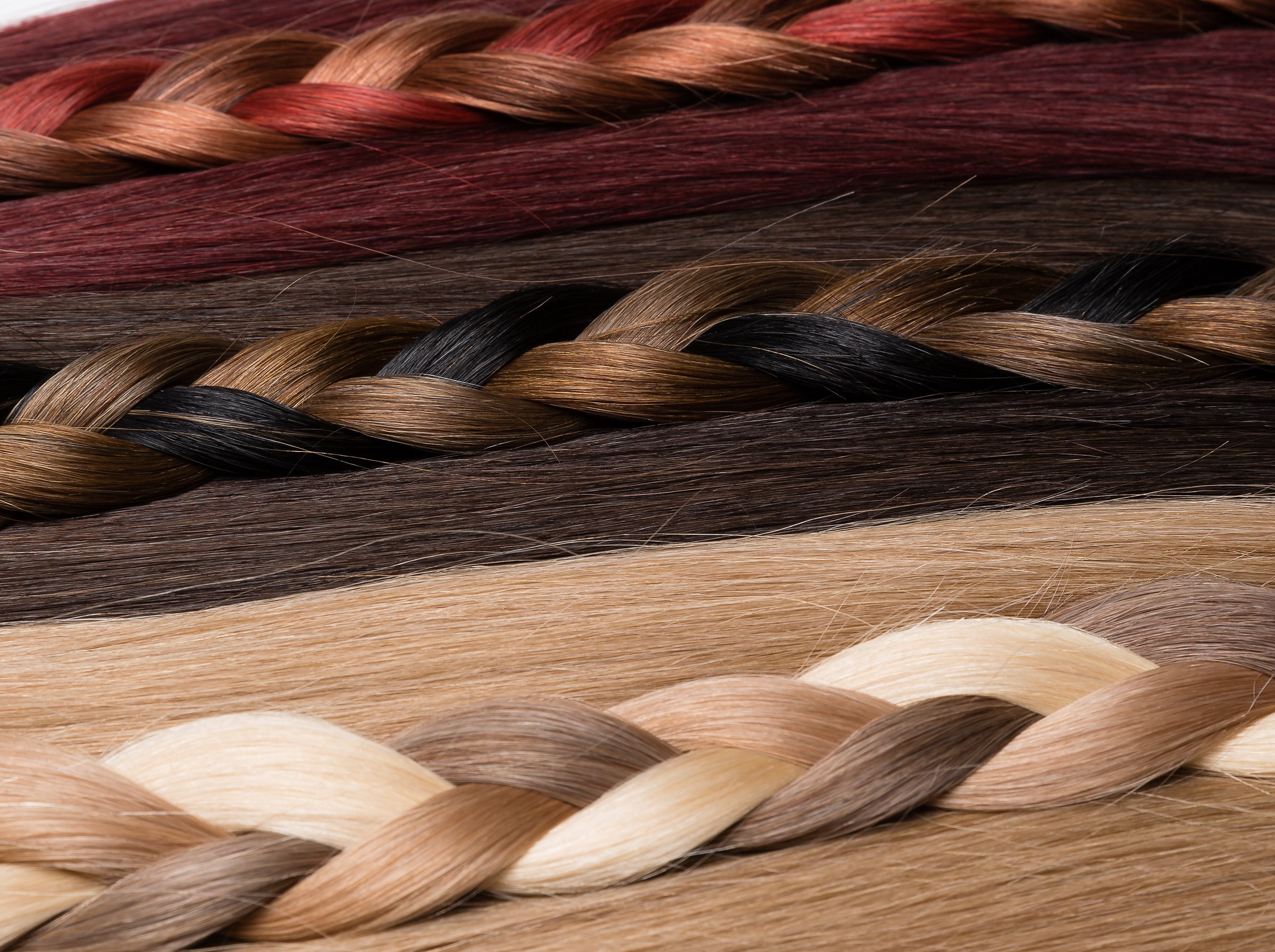
We often hear about Remy hair extensions, described as a better quality product, and therefore one which costs more. But what does “Remy hair” really mean? And what are the advantages of this type of hair?
The meaning of “Remy hair”
Hair is known as “Remy” when each hair in a lock or bunch is lying in the same root-tip direction.
The root-tip direction is the same natural direction in which the hair grows on our head.
It is vital to keep all hairs running in the same direction, because each hair (among its various components) has a layer of cuticles, visible under the microscope. These cuticles are like small scales, reminiscent of the scales on a fish, forming a protective layer on our hair and giving it shine.
If the hairs within the extensions have been mounted in opposite directions, the cuticles will be lying in opposing directions too, causing the hair to knot and tangle.
It is crucial to gather the hair in ponytails or plaits (secured firmly with an elastic band) before it is cut from the donor, to ensure that the root-tip direction is maintained.
If this does not occur, or if the root-tip direction of all the individual hairs is uncertain, the cuticles are removed by the hair extension manufacturers using a number of chemical procedures.
When the cuticles are removed, the hair is weaker and less shiny.
Ensuring that the hair is genuine Remy hair is therefore the first important step to take when purchasing hair extensions, but it is not the only one. The cuticles may have been damaged even if the root-tip direction has been correctly maintained, for example if they have been subjected to aggressive treatments such as decoloring (the same thing which happens to our own hair when we go to the hairdresser). The next step is ensuring that the hair cuticles are intact, and that these have not been removed.
Some extension manufacturers, who do not have access to healthy Remy hair with intact cuticles, or who want to save on costs, use lower-quality, randomly collected hair, where the root-tip direction of all the hairs is impossible to ascertain.
To prevent the hair from tangling once it has been applied, the cuticle is removed using processes which greatly weaken it.
Silicone-based products are then applied to this hair to restore body and shine.
The layer of silicone, however, only lasts a few weeks, after which the hair will appear damaged and will tend to tangle, becoming difficult to manage.
The different processes used for Remy hair with intact cuticles and non-Remy hair explains the difference in price of the various extensions: the former is a quality-tested product, while the latter is a product with less stringent checks performed at source, more perishable, and less aesthetically pleasing.
The importance of the raw materials
As well as the direction of the cuticles, it is fundamental that the hair is in perfect health when it is cut to be donated or sold.
Hair which has already undergone treatments such as decoloring would not be suitable for use in quality hair extensions, even if it is Remy hair.
For this reason, the health and the age of the donor are also important factors.
If the hair has never been treated, it is considered virgin hair: hair which is healthy and has intact cuticles.
If correctly cut, this type of hair can be used to create high quality hair extensions.
Virgin Remy hair, therefore, is fundamental in creating quality extensions, which maintain their beauty over time.
Our Remy hair
For our hair extensions, we use only top quality selected hair: cuticle-intact virgin hair bearing the “Best Quality Cuticle Remy Human Hair” quality seal. This hair undergoes a thorough decoloring process, one which does not affect the cuticle or hair structure. The process is very delicate, and may last up to 20-25 days, for light and blonde shades. The hair is then dyed using products which do not damage the hair. The result is hair which is integral, soft as silk, shiny, and easy to brush and to manage. Keeping the cuticles intact and all lying in the same direction is fundamental for quality extensions.
Note:
Inappropriate use of the term Remy is widespread, especially on the Internet, and has led to a great deal of confusion among professionals and others working with hair extensions. Unfortunately, use of the description “100% Remy hair” has become commonplace among those selling hair extensions: the truth is that genuine Remy hair, with intact structure and cuticles, is now relatively rare on the market, due to the high demand from consumers, and to the increased cost of this type of hair.






Leave A Comment